A guided tour, from our Sun to the edge of the universe
OrbitLab propagates orbits with the same gravity that shapes everything else. This page is a short tour for students, ordered from our own solar system outward to galaxies and the big ideas of physics. It uses real NASA and ESA images and three real recordings from space.
Use the Visuals menu to switch the interactive scenes between 3D, a lighter 2D mode, or still images. Every visual has a text explanation, and the audio has a transcript, so nothing depends on sound or a fast graphics card.
How we listen to space
Sound is a wave that needs a material to travel through, like air or water. Space is almost empty, so it is silent; a microphone floating out there would hear nothing. To study space we mostly use light instead: not only visible light, but also radio waves, X-rays, and more.
We can also turn measurements into sound, which is called sonification, and a few missions now carry real microphones. Several clips on this page are real data you can listen to: a black hole, a spinning neutron star, and two black holes colliding.
Our solar system
The Sun, our star
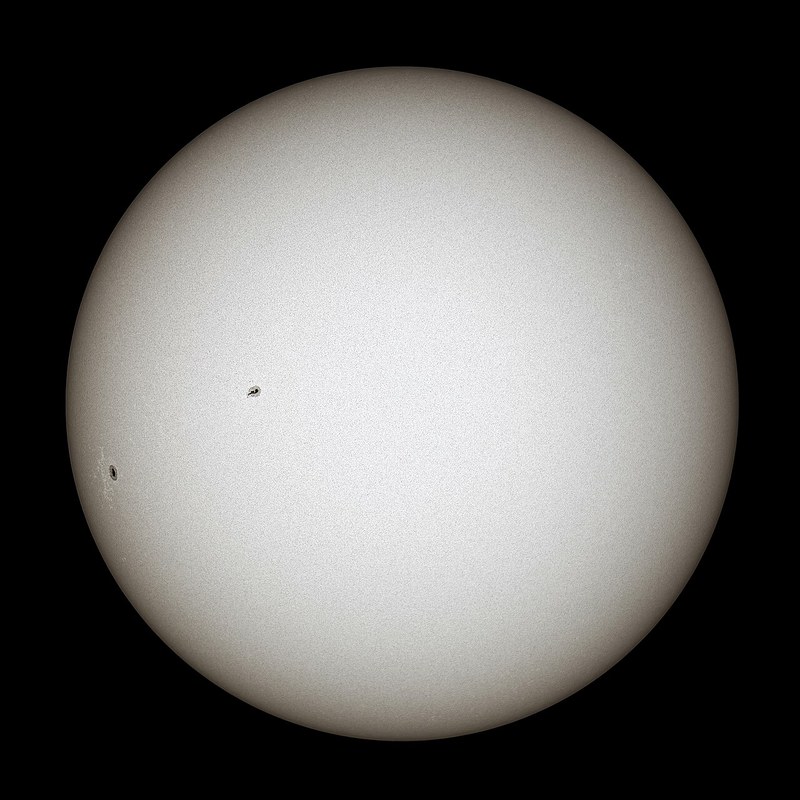
The Sun is a ball of hot plasma about 150 million km away, and it is also a star. Its light and warmth make life on Earth possible.
In its core it fuses hydrogen into helium, releasing the energy we see as sunlight. Storms on its surface throw out bursts of particles, called space weather, that can disturb satellites and power grids.
OrbitLab uses the Sun's direction to work out when a satellite is sunlit or in eclipse.
The planets
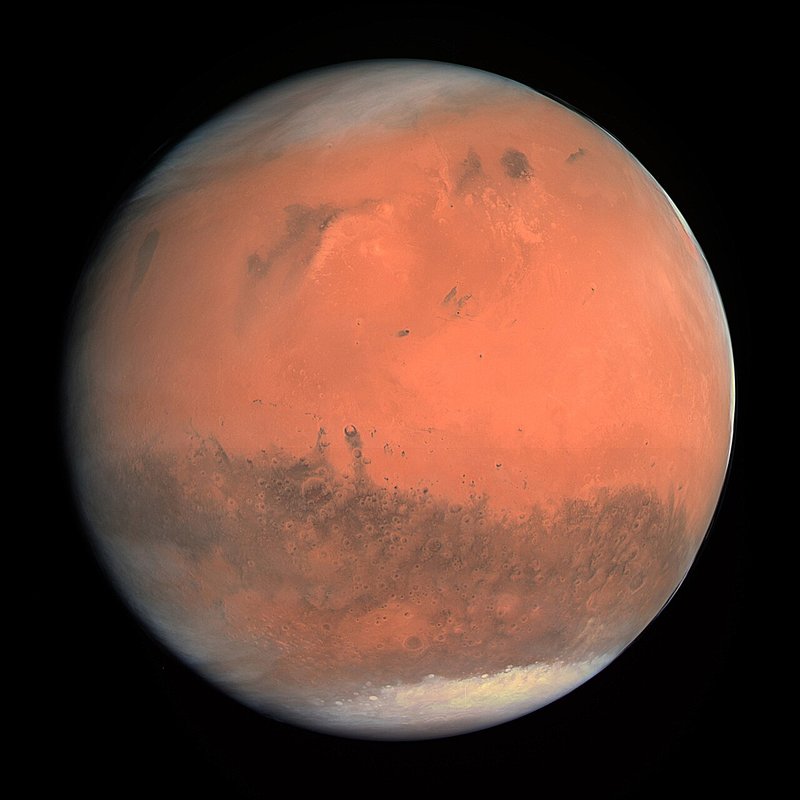
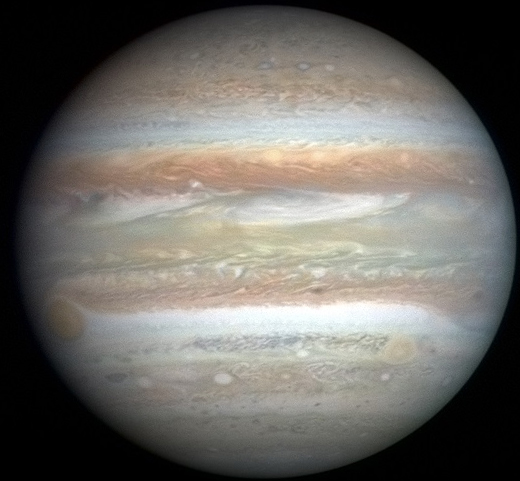
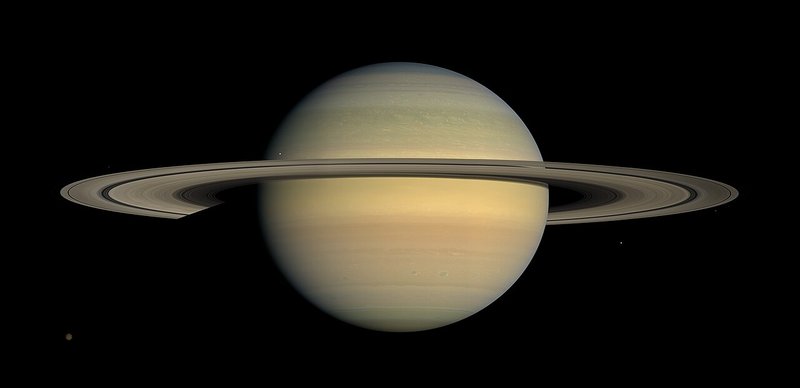
Eight planets orbit the Sun. The four inner ones are small and rocky; the four outer ones are giant balls of gas and ice. Mars is a cold desert we explore with rovers, Jupiter is the largest planet and carries a centuries-old storm called the Great Red Spot, and Saturn is wrapped in bright rings of ice and rock.
Planet explorer
Tap a planet to open its card and compare sizes, distances, day and year lengths, gravity, and moons. Use the search box (or press the slash key) to jump straight to any world, term, or mission.
Loading...
The solar system in motion
The same gravity that bends light around a black hole keeps the planets on their paths. Here a few worlds circle a central star to show orbital motion at a glance.
OrbitLab's propagator does the precise version of this for real satellites: it integrates the equations of motion to produce trajectories, ground tracks, and pass times.
The lives of stars
Where stars are born and die
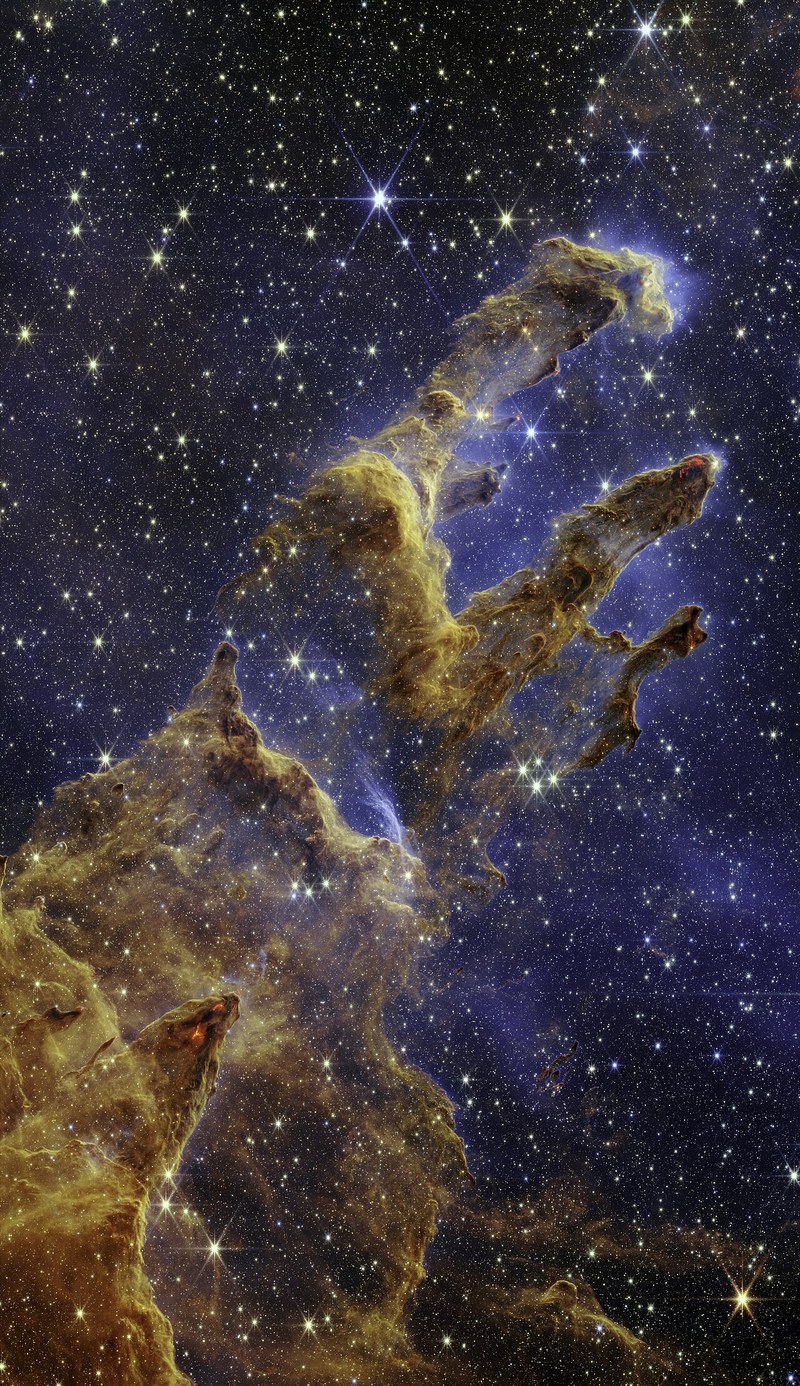
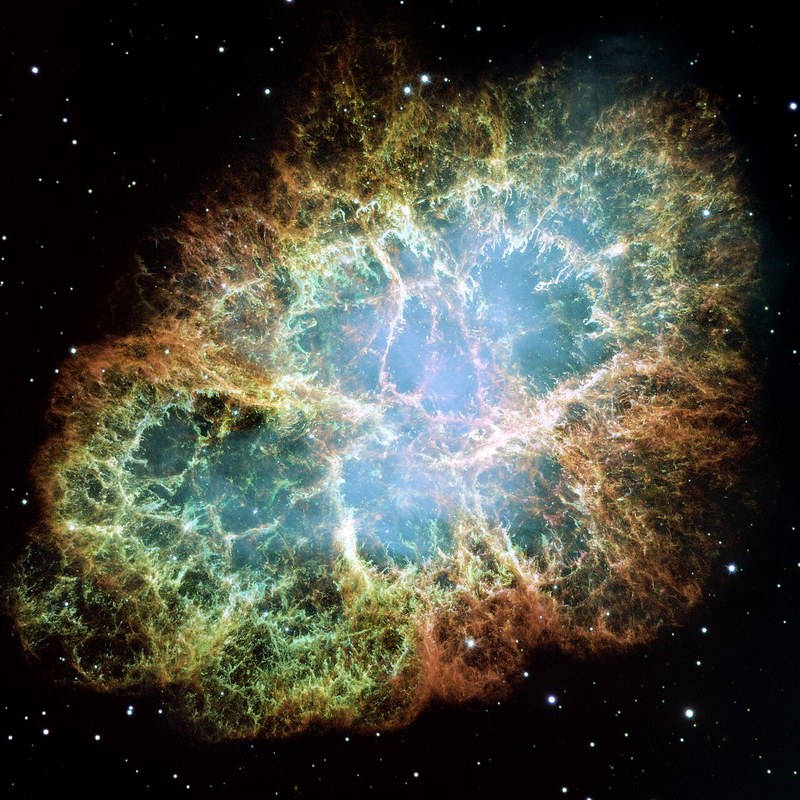
Stars are born inside giant clouds of gas and dust like these pillars, where gravity pulls material together until the core is hot enough to fuse hydrogen and shine. A star lives for millions to billions of years.
When a heavy star runs out of fuel, its core collapses and it explodes as a supernova. The Crab Nebula is the glowing wreckage of one such blast. The most massive stars leave behind neutron stars or black holes, so the atoms in your body trace back to the lives and deaths of stars.
Neutron stars and pulsars
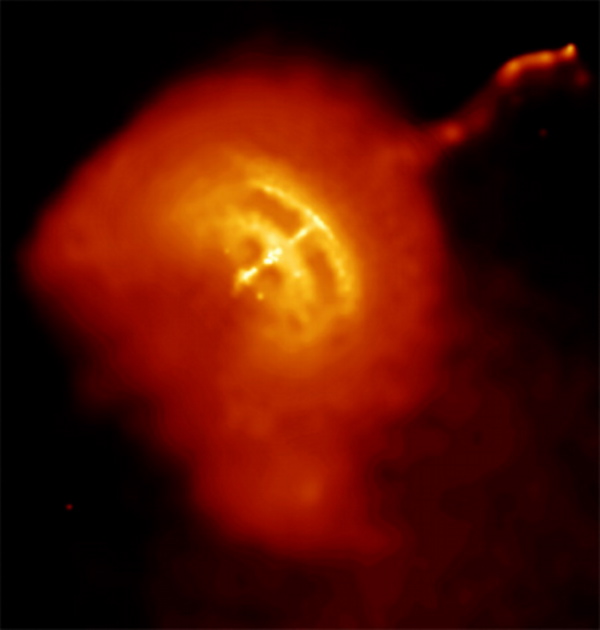
When a massive star explodes, its core can collapse into a neutron star: a ball only about 20 km across, yet heavier than the Sun. A teaspoon of it would weigh roughly a billion tonnes.
Many neutron stars spin quickly and beam radio waves from their magnetic poles. As a beam sweeps past Earth, like a lighthouse, we pick up a steady pulse, and we call the star a pulsar.
PSR B0329+54 turns about once every 0.71 seconds. Playing its pulses as sound gives the beat below.
Each beat is one rotation of the neutron star as its radio beam sweeps past us, recorded by radio telescopes and played as sound.
Sound: Jodrell Bank Observatory, University of Manchester. Reuse requires their permission.
Transcript and description
A steady, rhythmic thumping, a little faster than three beats every two seconds. Each thump is one turn of the neutron star, about once every 0.71 seconds.
Galaxies and the universe
Galaxies
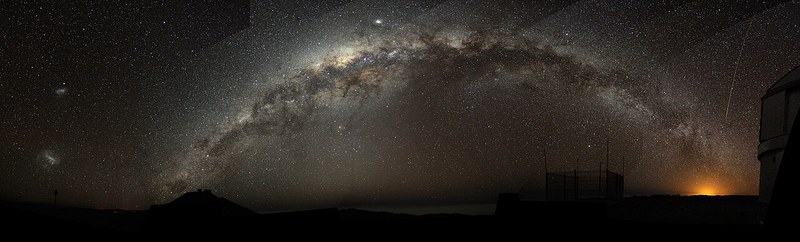
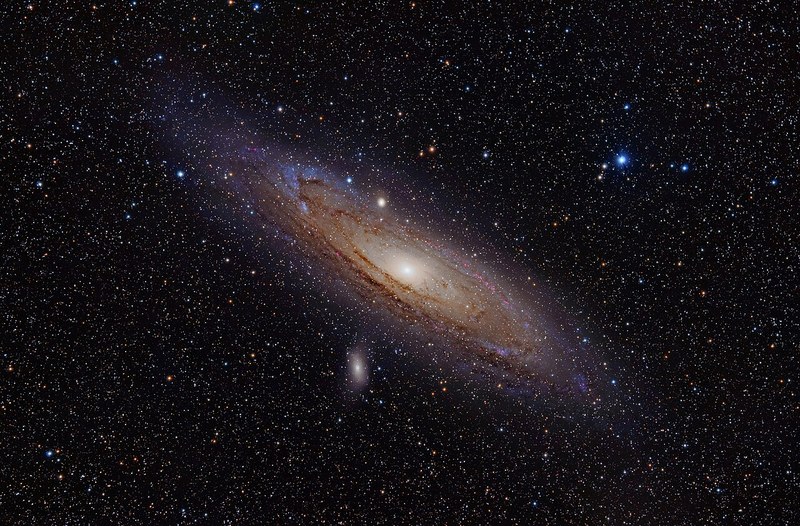
A galaxy is a huge collection of stars, gas, dust, and dark matter held together by gravity. We live in the Milky Way, a barred spiral of a few hundred billion stars; on a dark night its disc appears as a faint band across the sky.
Andromeda is the nearest large galaxy, about 2.5 million light-years away, and the most distant thing most people can see with the naked eye. It is slowly heading toward the Milky Way and will merge with it billions of years from now.
The expanding universe
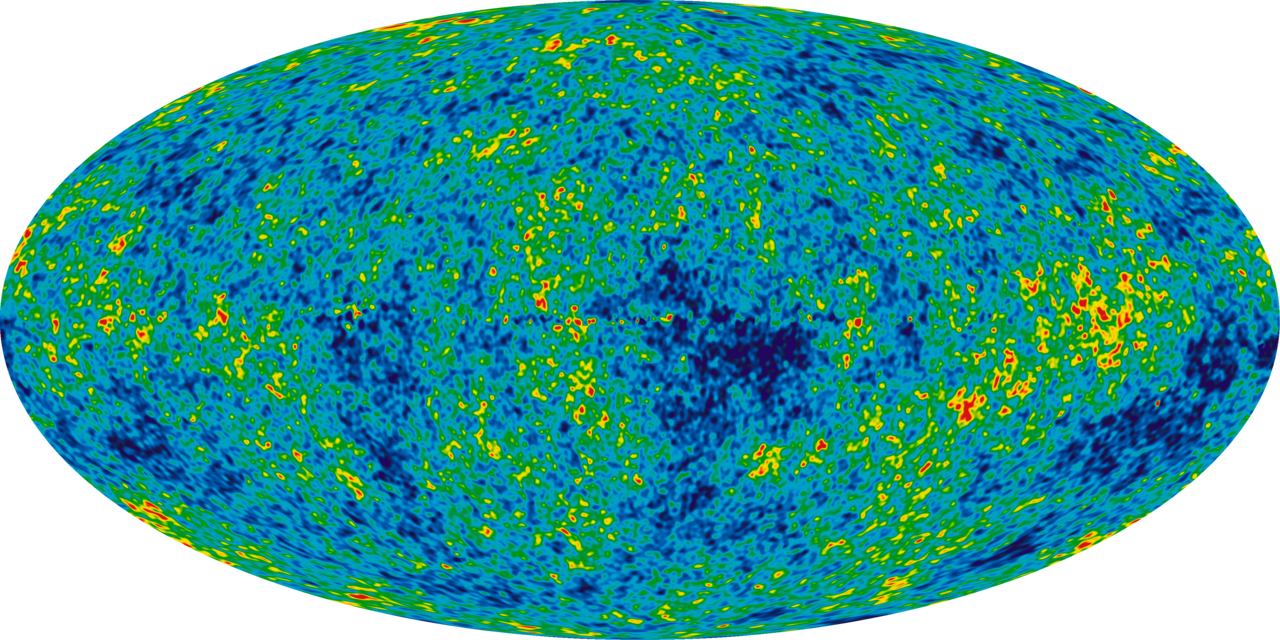
The universe is expanding: distant galaxies are moving apart, which means everything was closer together long ago. About 13.8 billion years ago it began in a hot, dense state, often called the Big Bang.
The faint afterglow of that early heat still fills the sky as the cosmic microwave background, mapped here. Its tiny temperature ripples are the seeds that later grew into galaxies.
Gravity and spacetime
Spacetime and relativity
Albert Einstein's special relativity (1905) showed that the speed of light is the same for every observer, and that space and time are two parts of one fabric.
General relativity (1915) went further: mass and energy curve that fabric, and what we feel as gravity is motion along the curve. A planet orbits the Sun because it follows the straightest available path through curved spacetime.
Einstein also explained the photoelectric effect that helped start quantum physics, and with Podolsky and Rosen he posed the EPR paradox about entanglement.
Black holes
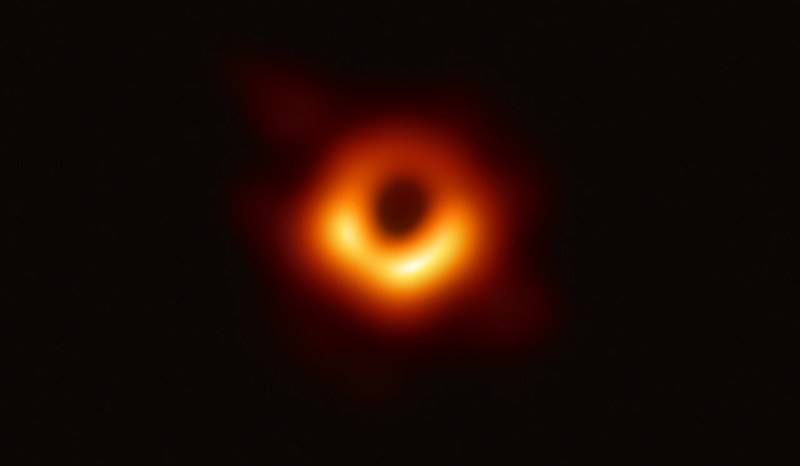
The event horizon is the boundary where the escape speed reaches the speed of light. Anything that crosses it, light included, cannot come back. For a non-rotating black hole its radius is the Schwarzschild radius, r = 2GM/c squared.
Spaghettification is what tidal gravity does up close: the pull on your feet is far stronger than on your head, so you are stretched lengthways. Stephen Hawking popularised the name in A Brief History of Time.
At the centre, general relativity predicts a singularity, a point of extreme curvature where the known laws stop giving answers.
In 2022 NASA turned real pressure waves rippling through the hot gas of the Perseus galaxy cluster, set off by its central black hole, into sound. The clip plays that data as both picture and sound.
Source: NASA / Chandra X-ray Observatory. Credit: NASA/CXC/SAO/K. Arcand, SYSTEM Sounds (M. Russo, A. Santaguida).
Transcript and description
A low, sustained tone rises and falls in slow waves while a sweep moves around the Chandra X-ray image of the cluster. The pitch is scaled up by about 57 octaves so it sits within human hearing. The sound represents real data; sound cannot travel through the vacuum of space.
Gravitational waves
When two black holes or neutron stars spiral together and merge, they shake spacetime itself, sending out ripples called gravitational waves. In 2015 the LIGO detectors caught the first one ever recorded, from two black holes merging more than a billion light-years away.
Played as sound, the signal sweeps upward in pitch and ends in a quick chirp at the moment the black holes meet.
The first detected gravitational wave, shifted up in frequency so it sits in human hearing. The rising tone tracks the black holes orbiting faster and faster before they join.
Source: LIGO Open Science Center (GWOSC). Credit: LIGO/Caltech/MIT (CC BY 4.0).
Transcript and description
A short, rising whoop ending in a quick chirp, under a second long. The rising pitch follows the two black holes circling faster and faster in the final moment before they merge.
The quantum world
Quantum ideas
A quantum system can sit in a superposition, a blend of possibilities, until it is measured. Two particles can become entangled, sharing correlations that hold even when they are far apart.
The no-cloning theorem says you cannot make a perfect copy of an unknown quantum state. It was proven by Wootters and Zurek, and independently by Dieks, in 1982, and it is one reason quantum cryptography can be secure.
These ideas are not Einstein's invention. He was often the sceptic, but his questions, like the EPR paradox, pushed the field forward.
Explore and reference
Space missions
A short timeline of milestones in space exploration, from the first satellite to the latest rovers and telescopes. Each step built the tools and know-how that make modern missions, and apps like OrbitLab, possible.
Loading...
Glossary
Key words used across this tour, in plain language. Throughout the page, dotted terms like this show a quick definition when you hover, tap, or focus them.
Loading...
Credits and notes
- Audio and video: NASA and LIGO data, and a Jodrell Bank pulsar recording. See
assets/audio/CREDITS.mdfor per-file sources and licences. - Images: public-domain and openly licensed images from NASA, ESA, the Event Horizon Telescope, and
Wikimedia Commons. See
assets/img/CREDITS.mdfor per-file credits, and verify a licence before reuse. - The interactive scenes are simplified illustrations, not physically exact simulations. The orbit propagator in the main app is the quantitative tool. 3D rendering uses Three.js, loaded only when the 3D mode is active.